
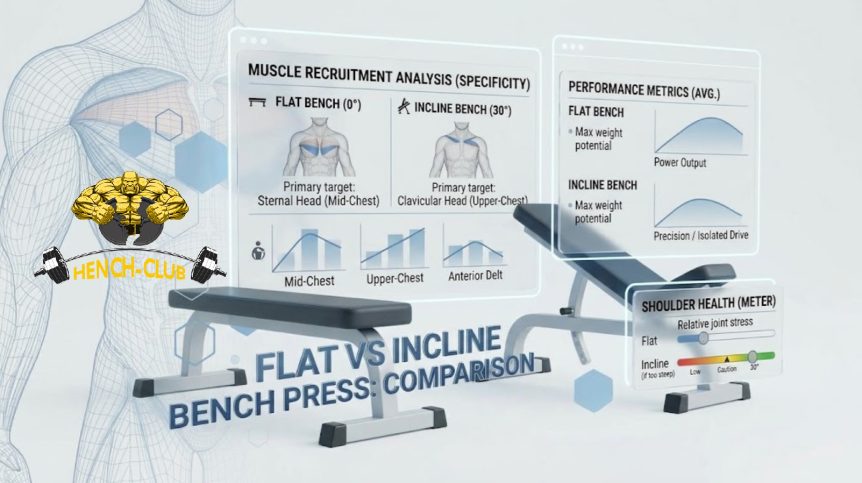
Flat Bench Press
- Primary Target: Overall chest mass, with strong emphasis on the mid and lower pectoralis major.
- Strength & Load: Allows you to move the heaviest weight and generates high overall neuromuscular activation.
- Shoulder Considerations: Places more stress on the rotator cuffs and requires high shoulder mobility and stability. [1, 2, 3]
Incline Bench Press
- Primary Target: Upper chest (clavicular head) and front shoulders (anterior deltoids).
- Optimal Angle: Best set between 15 and 45 degrees; going higher than 45 degrees turns it into a shoulder press.
- Joint Considerations: Often feels friendlier or safer on the rotator cuffs and shoulders than a flat bench.
Load: You generally lift slightly less weight compared to a flat bench because of the altered mechanical angle and extra shoulder involvement
When it comes to building a well-defined, strong chest, few exercises are as fundamental as the bench press. However, one of the most common debates in the gym is whether to prioritise the flat bench press or the incline bench press.
While both exercises target the pectoralis major (your main chest muscle), changing the angle of the bench significantly alters how muscle fibers are recruited, the stress placed on your shoulders, and how much weight you can move.
Here is a breakdown of how they compare, their key differences, and how to use both to maximise your chest development.
1. Primary Muscle Activation & Function
Flat Bench Press: The Overall Mass Builder
The flat bench press is the ultimate compound movement for upper-body pushing power.
- Primary Target: Sternal head of the pectoralis major (the middle and lower chest).
- Secondary Targets: Anterior deltoids (front shoulders) and triceps brachii.
- Biomechanical Advantage: Because your torso is horizontal, you can leverage a stronger position to move maximum weight. This makes it ideal for building overall strength and chest density.
Incline Bench Press: The Upper Chest Specialist
Setting the bench to an incline (typically $15^\circ$ to $30^\circ$) shifts the center of resistance higher up the torso.
- Primary Target: Clavicular head of the pectoralis major (the upper chest).
- Secondary Targets: Anterior deltoids (significantly more involved than on a flat bench) and triceps brachii.
- Biomechanical Difference: Moving at an upward angle requires more recruitment from the upper chest and front shoulders to control and push the load, helping fill out the area just below the collarbone.
2. Flat vs. Incline: Quick Comparison
| Feature | Flat Bench Press | Incline Bench Press |
| Primary Muscle Focus | Middle & Lower Chest (Sternal Head) | Upper Chest (Clavicular Head) |
| Shoulder Involvement | Moderate | High (Anterior Deltoids) |
| Max Weight Potential | Higher (Optimal mechanical advantage) | Lower (5–15% lighter than flat bench) |
| Best Bench Angle | 0% (Flat) | 15-30 Degrees |
| Primary Training Goal | Overall chest thickness & maximum strength | Upper chest shelf & balanced aesthetic |
3. Shoulder Health and Joint Stress
- Flat Bench Press: Pressing flat with heavy loads can put excessive stress on the anterior shoulder capsule or rotators, especially if done with an overly wide grip or elbows flared out at 90 degrees
- Incline Bench Press: While the incline inherently places more work on the shoulder muscles (deltoids), it often allows for a more comfortable path for the shoulder joint if set at a mild incline 15-30 degrees
Pro Tip on Incline Angle: Avoid setting the incline too high (45 Degrees or higher). Steep angles transfer the workload away from your chest and turn the movement into an overhead shoulder press. Keep the bench set to a low-to-moderate incline for maximum upper chest engagement.
4. Which One Should You Do?
Choose the Flat Bench Press if:
- Your primary goal is raw strength and pushing maximum weight.
- You compete in powerlifting or strength sports.
- You want to build overall chest mass and thickness efficiently.
Choose the Incline Bench Press if:
- You want to build a full, aesthetic upper chest (the “shelf”).
- You feel flat benching irritates your shoulders or lower back.
- You already have good lower/mid chest development and need to bring up lagging upper pecs.
5. How to Combine Both into Your Routine
You don’t have to choose just one—the best chest routines utilise both to ensure complete development.
Sample Chest Workout Strategy
- Primary Heavy Compound: Start with your main strength movement while fresh (e.g., Barbell Flat Bench Press or Barbell Incline Bench Press for 3–4 sets of 5–8 reps).
- Secondary Hypertrophy Movement: Follow up with the opposite angle using dumbbells for better range of motion (e.g., Dumbbell Incline Press if you started flat, for 3 sets of 8–12 reps).
- Isolation / Finishing: Finish with flyes or dips to target the chest through different planes of motion.
Would you like me to tailor a specific chest workout program based on your current equipment and training goals?